
The Difficult Lessons I Learned about America When I Left Academia for Corporate America

I recently read an excellent article by a young academic about climate change in which the author applied the social psychologist and psychoanalyst Erich Fromm’s concepts to the crisis. Since it has been such a long time now, I don’t think back that much anymore about my time in academia, but this particular piece hit a nerve on that day. I read the piece because the young author is part of a book club I’m in that focuses on the Frankfurt School of critical theory. (Incidentally, we’re currently reading Hayek’s Bastards by Quinn Slobodian, and I’ll be writing a review of that once I’m through reading it—having already read some of it, I will say this now: it’s a must-read.)
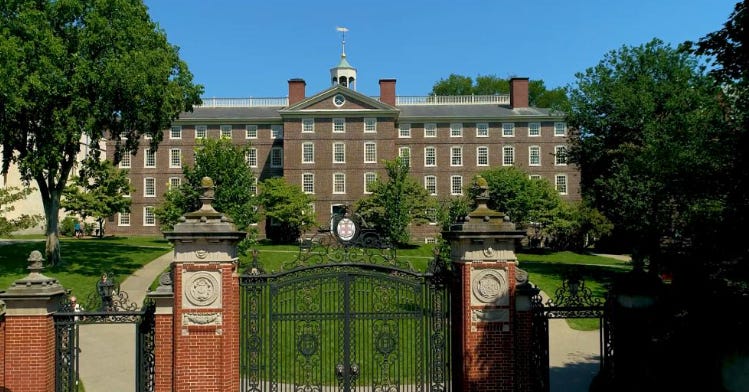
The choice to leave academia, at least for most of us, is fraught with complexity, struggle, and confusion. I made the difficult decision to leave my Ph.D. program in history at Brown University well over a decade ago for numerous reasons, which I won’t delve into here. I had completed all of my coursework at Brown and additional graduate coursework before that, as I already held another Master’s degree in the social sciences from the University of Chicago before entering my Ph.D. program at Brown. I also completed work at Harvard University as an Exchange Scholar with Professor Peter Gordon, a specialist in European Intellectual history. The latter piece, being an Exchange Scholar at Harvard, sounds extremely sexy, but I did it for pragmatic reasons. I sought out Peter because he was in my field of interest, and all the Europeanists at Brown were on sabbatical when I needed to complete my final year of coursework. The Ivy Leagues, along with the University of Chicago and Stanford, have an incredible exchange program by which you apply to the department you’re interested in working in (in my case, it was the History Department at Harvard), receive permission from your own department to go (in this case the History Department at Brown University), and then get accepted by the incoming department to attend classes. (Peter also agreed to be on my dissertation committee.)
I’m telling you all of this because I’m illustrating how deeply ensconced I was in academia. In addition, I had already written a dissertation prospectus and was preparing for my field examinations, so I was nearly shy of being ABD, which means “All But Dissertation.” Once you’re in this deep in the academy, it runs in your veins and is part of your identity. I had already presented papers at numerous conferences worldwide, too, and I was well on my way to, as we say in academia, “dissertating.”
There should be no romanticizing of academia, as it has more than its fair share of problems, which have been written about exhaustively, and rightly so. Many a Saturday night—those rare occasions when we graduate students could congregate for a drink after a long day of researching or reading—were spent bemoaning the multitude of problems of the academy, offering up solutions that, no doubt, others had come up before our time.
But I soon found myself outside that environment, a distant memory growing foggier by the day, dusty in my mind, like some of the more decrepit stacks in the deeper parts of the libraries that had once been my frequent haunts. I eventually wound up in the slick, bright, steel-and-glass confines of corporate America, a simulacra of the real world, awash in ignorance, arrogance, and speed. The know-nothings in leadership around me astonished me. After leaving a cocoon of knowledge, the majority of people, again, those in upper leadership, I soon found myself around were devoid of knowing much of anything. Yes, there were a few with knowledge of things, with whom I’ve created longstanding bonds, and for whom I’m grateful to have as friends, but the vast number of these people knew nothing. Even worse, they lacked any curiosity to know anything. Who were the worst culprits? As I said: those at the very top. They knew only business, scaling things, ensuring we were moving at speed to accumulate more capital for the head Fred. The entire environment was all about conformity of thought. Everyone, everywhere, in every meeting claimed they wanted ingenuity, creativity, people who thought “outside the box” (yes, leaders really said that), but once we dispersed from these meetups, having heard this repeated lingo, and we went back to our cubicles, our work duties told us otherwise. There is nowhere in America that demands conformity more than corporate America, with its fascistic, top-down, hierarchical structure. You quickly learn what being a cog means in the system. You also realize that corporate America is anything but the “real world,” something they love to tell themselves. It’s so far removed from the real world, it isn’t even funny. More than anything, it fetishizes fakeness at the expense of the real, obsessed with pontificating in false language, forging laughably dumb neologisms that would make me weep when forced to use them.
Of course, anti-intellectualism is, as the saying goes, as American as homemade apple pie. It is no different in corporate America than elsewhere here, even within academia. That said, in academia, non-conformity still flourishes, free, individual thought still exists, and independent projects, based upon what peers before you have done, are still expected (this is precisely why the Trump regime is intent on destroying higher ed). Not so in corporate America. The semblance of individual thinking is a sham, that is, unless you are in leadership and you’ve managed to figure out how to help the company amass capital. Then you’re an innovator! A thinker! A winner! Otherwise, shut up, put your head down, and do your tasks.
This work is devoid of any history, too—it is deeply suspicious of history. It is ahistorical. All subjects are stripped of their histories, their personalities, their beingness, something Marx wrote about exhaustively when he analyzed our alienation from our species-being. Imagine how jarring that was for me, after having spent much of my adult life in a world in which my Ph.D. advisors constantly asked me about my own thoughts. It was a living nightmare every day, walking into a brightly lit office, an ultra-hygienic, sanitized world, devoid of curtains, books, dust, history, intellectual life.
On top of that, one’s days are highly regimented. In academia, research, reading, and teaching are highly demanding and time-consuming. Yet, the onus is on you to design your own day, to hold office hours for your students, to research the work you’re doing, to read the appropriate books or articles, and to determine what you will do every day of the week. Corporate America, on the other hand, requires you to go into the office five days a week, eight hours a day, and sit in the same spot, attend the same meetings, and take the same breaks. There is no variation, aside from the lone doctor’s appointment, which your manager must approve. The banality of it all is the height of alienation, not to mention the monotony of the tasks at hand.
This world does not foster questioning anything around you —of other people or your own surroundings—again, it is ahistorical. It breeds, props up, and rewards ignorance. It allows Americans to further wallow in ignorance of the world and of themselves.
This picture is grim. It should be. It is. While I write that many Americans stuck in these environs are ignorant, many others are not. There is resistance within these spaces. There are cracks of opportunity to seek to know things, despite how these spaces function. Much to my surprise, I found people who were different, who questioned things, who saw beyond the ahistorical, glass-and-steel confines in which we were all entrapped. Afterwards, over drinks, we would openly mock our leadership and the managers who went along with them. We were the ones who knew what freedom tasted like at one point, as we would clink our glasses together and cheers one another. The false façade painted for us was a thin veneer of bullshit, painted by leadership, that we didn’t buy, and we released the pressure valve together through the late evening, one filled with laughter, camaraderie, and togetherness.
Does leadership know about this mockery, the type that inverts their power, that sees the sheer nakedness of their greed and their complicity in a system that cares about one thing and one thing only: the accumulation of capital at the expense of everything else? Perhaps. Does it matter? Probably not. What does matter are the resisters, the ones who get out, the ones who seek to build alternative worlds, who know that some day they will become worthless to capitalism. Eventually, in corporate America, unless you are at the tippy-top of the corporate chain, you are rendered useless, and that’s why so many people turn against it when they learn they are disposable. Instead of grieving that moment, it should become a moment to celebrate. Embrace your worthlessness sooner rather than later, explore alternatives, find your species-being, despite what you’re up against, and leave before it’s too late. New worlds are being created, and new chances to push back against this false façade of satisfaction do exist. Who knows? Maybe you’re one of those people who could make one of those worlds. Perhaps we’re waiting for you to step up to seize the opportunity to do it. Why wait? If not now, then when? Rest assured, your desk won’t miss you, and neither will leadership.
Absolutely what the way life as a cog is. Glad I am out of it.
as a current ABD my problem is , and this just might be an issue with my dept or school though maybe not, that academia is becoming more corporate and meritcratic and stuck in groupthink. I feel there is maybe one student, who is adjacent to my program i can share my honest thoughts with. its about grades and popularity not independent thought. I'm facing very difficult moral choices at the moment, esp as a phd candidate in his late 40s with few economic resources