
Autonomy and Creativity Reclaimed in the Commune
A Conversation with Scholar Kristin Ross

This past summer, I had the pleasure of reading Kristin Ross’s The Commune Form: The Transformation of Everyday Life (2024), and I wrote a summary about her work here on my Substack (it was an enjoyable piece to write, just as pleasurable to create as it was to read her book).
Ross is a professor emeritus at New York University of Comparative Literature. Her area of expertise is French literature and culture of the 19th, 20th, and 21st centuries.
I reached out to Ross a few months ago to see if she’d be interested in having a conversation about her recent book, and she was amenable to having one. Today, I called her in Paris to discuss it. It was a delightful conversation, and I’m excited to share it with all of you. I highly recommend buying her book. It’s insightful, timely, and solution-oriented, especially as it relates to ecosocialism and reclaiming one’s autonomy from capitalistic structures of exploitation via the commune form. In it, Ross provides concrete examples of communes and how people have organized together in experimental ways, and reorganized their lives in a manner that is better suited to their own dignity in communal settings.
The following interview is edited for clarity and brevity.
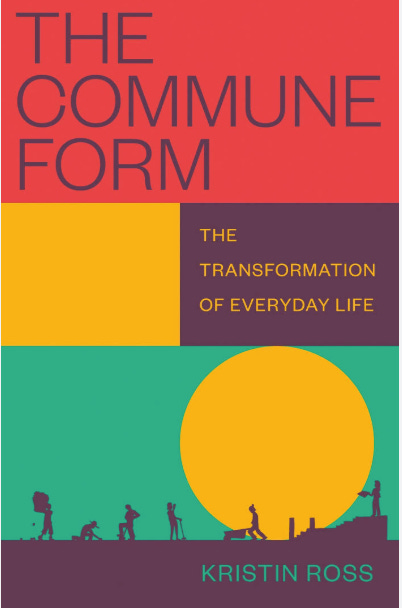
CCJ: Even though I reviewed your book on my Substack in the summer, I now have nearly 1,300 subscribers, some of whom may not be familiar with your book. You published your book in 2024. Let’s talk about the premise of the book and why you wrote the book when you did. What was the impetus?
KR: For some time, I’ve really been interested in the question of political memory. Why is it that certain events from the past appear and have new relevance to us in the present? And it’s not automatic. It’s usually something completely unscheduled. That has been the question that has preoccupied me in my work, which has to do with the political memory of big events in the history of the left. You know, like May ’68 or the Paris Commune. They look like French events, but they exceed the national context. It was my work on the Paris Commune that caused me to be invited down to an ongoing occupation in southern France, called Notre-Dame-des-Landes. People may be familiar with it under the acronym ZAD (Zone to be Defended). They wanted me to come down and talk and have a discussion about whether or not there were any real continuities between what they were trying to do in protecting farmland and what the 19th-century Communards in the capital city had been trying to do. So, I went down there, and thinking about that question—the origin—those discussions were at the origin of the book, which tries to think about what the possible commonalities of experience are between these two political experiments. Why is experimenting so important? And why does it so frequently take the shape now of these creative occupations?
CCJ: Yes, I’m thinking of Zuccotti Park and Occupy.
KR: Yes, exactly. In the background, too, of what was going on with the ZAD are the earlier occupations of 2011 and the movement of squares. Everything that happened from Madrid to Istanbul—there was a real turn at that point to a politics of occupying and inhabiting. That was really intriguing to me, and I’ve done a lot of work on that, as my previous book, Communal Luxury, was about the 19th-century experiment, the Paris Commune, so all of those things were on my mind when I decided to pull it together into a little book. I wanted to write a very short book, and I think I succeeded [laughs]. The other question behind the book had to do with the capitalists’ destruction of the lived environment in our current context. You don’t need to know much more, really, about capitalism’s destruction of the environment. We already know everything we need to know. We’ve known it since 1962, when Rachel Carson published Silent Spring. We’ve known it since the 1920s, when Jacques Ellul and other people were talking about the risks of technology [and the environment]. We’ve probably even known about it since the 19th century, with individuals I wrote about back then— Élisée Reclus, Peter Kropotkin, and William Morris—who all developed proto-ecological thinking. They didn’t have the word then, but that’s what they were doing. If we already know everything, then there’s no point in continuing to predict catastrophe; say we can’t do anything because it’s way too complex; there’s no room anymore for roundtables. It’s time for action, which is why I conclude the book with that group in France called Soulèvements de la Terre [Earth Uprisings Collective].
CJ: Let’s talk about the Communards and the Paris Commune of 1871. I wanted to return to that. You mention that you worked on that in your previous book, Communal Luxury. Returning to 1871 and the Communards, can we talk about why it resonates with this commune today?
KR: Yes, it was an experiment, and workers wanted to reclaim their social life, their life, and reorganize their social life according to principles of association, cooperation, not competition, those kinds of principles. They wanted to organize their everyday life in those terms. And for 71 days, they did it.
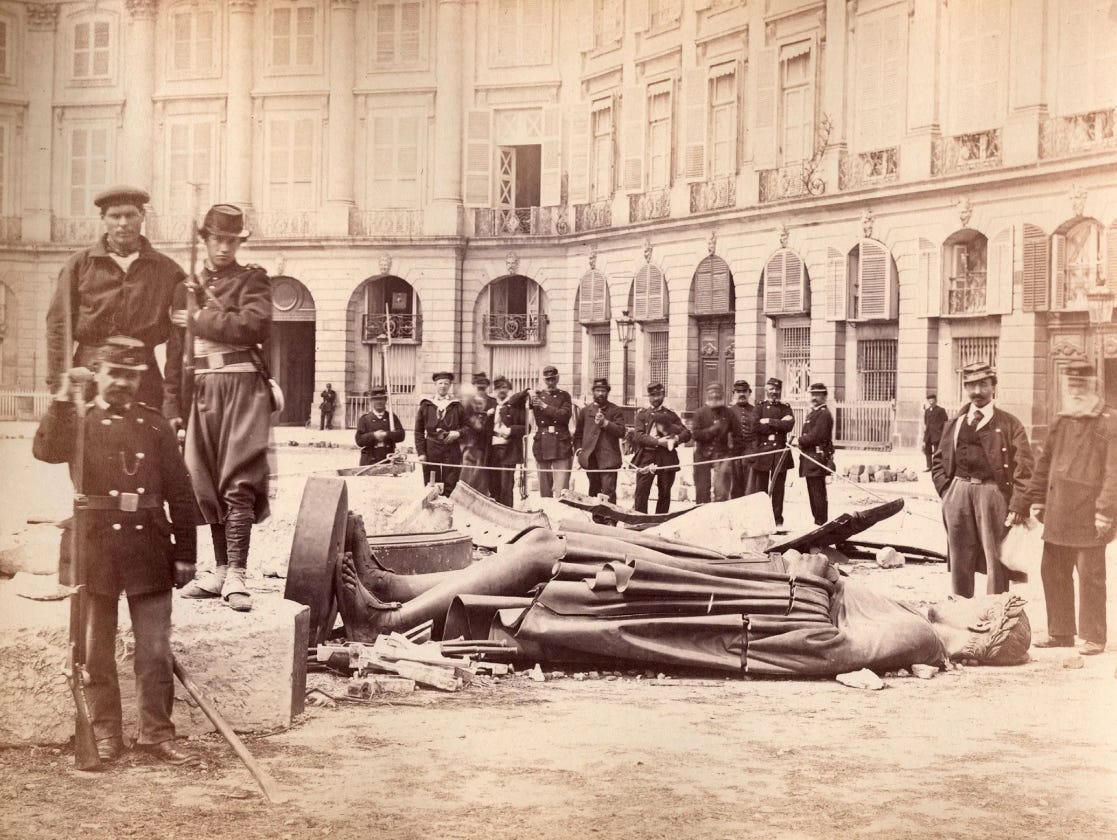
I was drawn to the idea of communal luxury, which I found in the manifesto written by the artists and artisans working together. That was already a major thing. At that time, artists were only people who painted oil paintings or made sculptures. Everybody else had no way of having any status, making a living, or being able to sign your work. It was divided between fine art on the one hand and artisans on the other. During the commune, these two groups decided, ‘Hey, let’s just say there is one kind of artist, and that’s all of us.’ So, they made a manifesto accordingly, and in the last sentence, they say, ‘we will work for our own regeneration, for the universal republic, and for communal luxury.’ And I thought, ‘Wow, what could that be?’ [Laughs.] Luxury, by definition, is for the few; it’s not communal. It’s this great oxymoron, and I thought, what could that mean? That’s what the book is about. Communal luxury is another way of talking about all the ways we are dispossessed, which are not directly economic. I’m enough of a Marxist, ultimately, it does come back to the economy, but ways of being dispossessed of your time, of your aesthetic pleasure, of your ability to work together with others, to have a say on what your future is going to be—all these dispossessions, dispossession of dignity, dignity of work, all these things. It’s a way of talking about the importance of pleasure and the aesthetic in social transformation and individual transformation, too. These artists and artisans thought that everyone has the right to live and work in a pleasing environment. It doesn’t sound like much. It doesn’t sound really radical, because in Victorian England, everyone was starving to death. But if you think about it, if you think about that demand, or that right, then fulfilling that demand involves completely transforming our entire relationship to labor, to art, to nature. It’s a transformation of what it is a society actually values, what it counts as wealth, and what it’s willing to defend. That’s what was on the mind of the Communards when they took over their city, said it was their city, and then they tore down a bunch of things they didn’t like [laughs].
CCJ: [Laughs.] Yes, I’ve seen pictures.
Returning to the commune. I absolutely loved the parts on time and place, and specifically what you wrote about locale, which you delve into in depth. But I wanted you to expand upon how time is different on the commune, how the commune organizes things, specifically related to time, and how they manage their relationships in contrast to capitalist time.
KR: When I went down to Notre-Dame-des-Landes, they had been occupying for several years and were involved in communal farming. When you eliminate salaried labor from the scene, everything changes pretty quickly. No one is getting up to go to a job exactly, but everybody is working hard. It is task-oriented. There are always tasks that have to be done. But the rhythm of who is doing the tasks, and when it has been organized by the people doing it, well, this changes everything. I tried to think about what an interruption is. People would get interrupted. You might be fixing a tractor or repairing a tractor, and people would come by and say, ‘We really need to write a statement about the strike happening in Nantes right now. It’s really important.’ So, you stop repairing the tractor and do this intellectual labor. Then you eventually go back to the tractor.
Also, money was not a big part of things. Money was there. It was shared. The way money came in and came out was... because you do have to think about the political economy of these things, and people were living and sharing with what they had. Some people had this very minimal kind of unemployment that the French state offers. It’s nothing, but it’s something. And then you put that together in a common pot. And maybe some people were working part-time off the ZAD, some vegetables were getting sold, and then there were donations. There were donations, particularly whenever there was a bad intervention with the state. That actually backfired quite a bit on the state, because this meant that people began to support them enormously, including financially, for what was going on.
When money and salaried labor are absent from the scene, time moves differently because people have more of a capacity to organize their lives according to different rhythms.
CCJ: We’ve touched on this here and there, but it’s about the land, and how it relates to resistance and ecosocialism.
KR: Early on in the book, I comment, and people forget this fact, but in the 18th century, all political battles were about land, because there were no factories. I have this strange feeling that we’re returning to that again now. The whole way in which land grabs are occurring, whether it’s in Gaza, the entire situation in Africa, with China going in, the new level of extractionism, and grabbing every single inch of land that remains. It’s very palpable that land is now at the center of all political questions, and of course, in the current ecological crisis, this is all the more true.
I tried to think about that very material aspect, along with the perception that Henri Lefebvre made back in the 1970s when he said, ‘Every battle over land necessarily creates the strangest alliances.’ I find that really interesting. It’s not about ideology exactly anymore. It’s about people from very different walks of life and using very different political codes, coming together to defend the usage of the land. We saw that in the Dakotas with Standing Rock and in the U.S. with Stop Cop City, and those are the two most vivid examples. It’s striking, the kinds of social groups that come together in these battles of territory.
CCJ: I also wanted to discuss how capitalism is at war with autonomy. I wanted to explore how the commune provides autonomy that one can’t find within capitalism.
KR: If you look at it from the point of view of capital and the extension of infrastructure, and in the book, I use international airports, which are already outdated. Now it’s AI data centers, Amazon fulfillment centers, which directly threaten the lived experience of a territory. And when I say territory, I mean a place that’s already self-conscious, a place that has not become habituated to destruction or has not given in to economic fatalism or technological fatalism. So, there is a direct battle that this expanding infrastructure poses against the autonomy of the way that people want to live their lives. You have to make a territory. You have to have the capacity to work together to do it. It’s only once you’ve posited the territory that you can see most clearly that way in which it’s threatened, and the way it needs to be defended. The act of defending makes the community.
CCJ: One of the things that comes to mind for me is what they’ve been doing in Portland against ICE. Would you agree?
KR: Yes, I think that’s great. It’s so funny.
CCJ: It is so funny!
KR: Do you mean the animal costumes?
CCJ: I do! And I’ve written about it, about how it’s a revival of the carnivalesque and the topsy-turvy, inverting the world and the mockery of power.
KR: You should read David Graeber’s piece on why police hate puppets. Police really do hate puppets. They really do. They can’t stand them because they don’t know what to do around them.
CCJ: I’ll have to look that up! [Laughs.]
Returning to your book and wrapping up this wonderful conversation, I really appreciated your remarks on defending territory, which goes back to occupation, and that’s what I found so inspiring about Occupy. They were seizing areas and occupying them, claiming them as their own—Zuccotti Park, with its free library, free healthcare, free childcare, being the greatest example.
KR: Yes, that’s exactly what the commune form is about, and I started with this intuition, that defense—the act of defending—creates a stronger solidarity than the act of resisting. I was trying to figure out why, and it seemed to me that when you are resisting, you’ve already lost the battle; you’re letting the state set the agenda; you’re attributing all the power to the other side. You can only resist.
CCJ: I thought that was a brilliant insight, and I’ve thought about the difference between defending and resistance a lot since reading your book.
KR: It’s not cut and dry. There’s always some give and take between the two, but the main thing is: What is the starting point? And with defense, it’s always with something that you love, positivity, something that you cherish, and that you don’t want to lose.
CCJ: I do think this notion that you’re already on the opposing side, and that the state has already set the agenda, is interesting with resistance.
KR: It gets back to that temporality question that you asked earlier. Defense has a different kind of temporality because you are setting the agenda.
CCJ: For people who aren’t familiar with communes, how do you explain to readers that communes aren’t seizing land?
KR: [Pauses.] I go back to this amazing insight again from Henri Lefebvre, who says that, ‘people cannot constitute themselves as political subjects unless they create a space.’ By space, he means both a social space and an actual physical space, so that means you have to be working with other people to build these kinds of autonomous spaces of collective decision making, collective life, collective pleasure, and taking individual and collective responsibility for the means of subsistence, and keeping those places going. And that’s exactly what Kropotkin said revolution is. Revolution has to happen at a scale that people can experience, and they have to engage in these kinds of experiments with usage over ownership. The example I always use is when the 19th-century Communards took over the city. A lot of the rich people fled to Versailles. They abandoned their apartments, their little work studios, and places like that. Eventually, the commune decided to occupy those spaces, and it wasn’t a transfer of ownership; ownership was considered at the level of the entire community, so it made no sense for those spaces to go to waste and remain unused. It’s exactly the same kind of gesture that the landless peasants of Brazil did when they found a fluke—a strange sentence—in the Brazilian constitution, which says something similar. It says, ‘if no matter who owns a piece of land, if it has gone unused—I can’t recall the amount of time, say 5 years—people have the right to farm on that land.’ So, these are the kinds of examples that Lefebvre would call appropriation, taking, or building experimental places that, for him, the prerequisite to class struggle or the prerequisite to social revolution was that kind of activity. It is those kinds of activities that actually create dreams, not the other way around.
Fin
Ross’s book has been translated into several languages, most recently into Serbian. Her book is available for sale from Verso Books. (Again, I encourage you to buy it—it’s a fantastic, short, insightful read, chock-full of hopeful anecdotes about the commune form!)
Excellent interview. Just bought the book.
Definitely going to be seeking the book out now