

When Will We Be Ready?
A Reading of Tara Knight"s "When The Moment Came, We Weren't Ready"

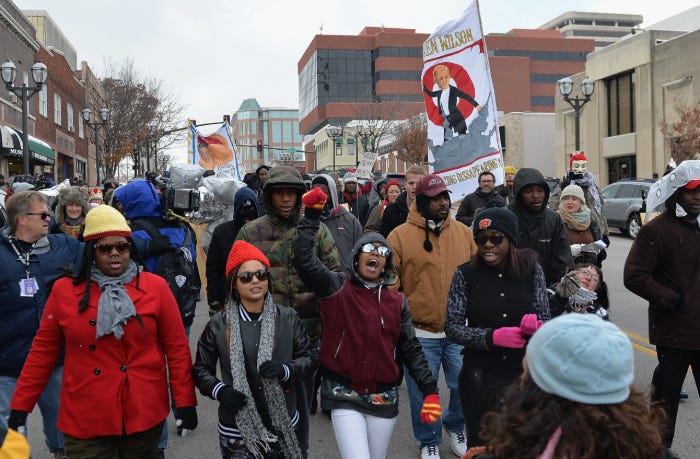
In a stunning and provocative piece, “When The Moment Came, We Weren’t Ready,” Tara Knight tells those of us on the left, especially those of us who are white, what we need to hear: “the Left makes black people do the work just for us to lose the particular grief of people who are very good at autopsies and have never once arrived before the body hit the floor.”

So, what does it all mean? How did we get here? And where do we go from here? These are the pressing questions Knight raises and incisively, in part, answers for us in her brilliant essay.
She goes on to write:
Ferguson was slaughtered and became a hashtag. Me Too became a ledger of named men, most of whom are fine, several of whom have podcasts now. (Ugh sorry Jenna) 2020 became murals and a Juneteenth federal holiday, which is the legislative equivalent of a fruit basket, and the largest rightward electoral realignment in a generation.
Things are stolen, betrayed, wrapped in burial gauze, and entombed. Remember Sandra Bland? You probably do, or at least I hope you do. Knight recalls her well, as does most of the (white) left. But so what? Everything analytical was already provided for us to understand what would happen to her, Trayvon Martin, Michael Brown, George Floyd, Philando Castile, Breonna Taylor, and the slew of other Black women and men mercilessly slaughtered by police. We just chose to ignore all the writings that came before their state-sanctioned murders that could have made their deaths preventable. Knight calls this preventability “the gap” and asserts that it is neither new nor accidental. And here we are, and the next murder of a Black or Brown person is upon us. And it is, just like the previous murders I listed, entirely preventable.
At the heart of these things, Knight accurately contends, is economics. But instead, centrist Democrats, “who discovered class the moment race entered the room,” treat identity politics as a distraction. The real constituency was the working class.” Yet it was “captured by its own graduate students” who “started talking about language instead of power, and this is why we can’t have nice things.” (The right, of course, also talked about identity politics, but Knight argues that they talk about it with more honesty.)
Then we turn to 2008, and symbolism took hold when Barack Obama won. Knight insists, however, that his 2008 election was real, but that he, as most of us know, governed from the center-right. Drones were used to kill Brown people in places like Afghanistan. The wealth divide between Black and white people grew, and the housing crisis hurt Black Americans in profound ways. But, as Knight writes, “at least there’s someone who looks like us in the room.”
In short, she writes, “You get the symbol. You don’t get the policy.”
Then Ferguson happened. “Hands up, don’t shoot.” As Knight says, “it was just another Tuesday, until it was filmed.” The cops couldn’t control the narrative, so white people finally saw what had been happening for decades, hell, since the plantations work colonies had existed: terror being meted out against innocent Black bodies. Darren Wilson's shooting of Michael Brown on August 9, 2014, was not new. Knight continues:
The footage went everywhere before any official narrative could get there first, which meant that for possibly the first time in American history, a significant portion of the white public was unable to simply take the police account as given, because the footage was right there, and the footage said something different.
Black Lives Matter already existed, having been founded in 2013 by Alicia Garza, Patrisse Cullors, and Opal Tometi in response to George Zimmerman’s acquittal for the cold-blooded murder of Trayvon Martin. But, as Knight explains, “The American left encountered this formation and did what the American left does: absorbed the vocabulary and managed the politics.”
(This makes me recall the leftist white men I knew in college. They were older than I was. They insisted that the material and economic conditions of the world were what mattered the most—that’s what needed to be changed. They diminished race, sex, and LGBTQ+ issues. These were all secondary matters, they told me over and over again, when I would raise questions about them. I no longer speak to these men, who were older than I and thought wiser than I. I’m glad I don’t engage with them, but I hope they’ve changed their tune, but somehow I doubt they have.)
Knight then addresses Harvey Weinstein and the Me Too Movement. She does not find this of interest. After all, she explains, Catharine MacKinnon, a legal scholar whom I discovered when I was just 16, wrote about men of this nature, “had named it as a feature and provided the legal framework for addressing it as sex discrimination in 1979, in a book the legal establishment spent the following decade declining to take seriously until they couldn’t anymore.” Furthermore, Knight notes that the “Combahee River Collective had named in 1977 the specific way that Black women’s experience of sexual violence was organized by the intersection of racial and economic and sexual power in ways that made white liberal feminism’s framework constitutively unable to account for it.” In a word, the analytical literature had existed for decades. Similarly, as Knight points out, Tarana Burke created Me Too in 2006.
It’s both amnesia and willful ignorance to overlook what's already there and available.
Most importantly, however, the wrong question was being asked about Weinstein. No one was asking a structural one. As Knight brilliantly writes:
The question “what did Harvey Weinstein do?” is answerable and generates enormous public attention. The question “what conditions made Harvey Weinstein inevitable and what would have to change to make him impossible?”
The latter question, which, again, is structural, is far more challenging, requires much thought, and presses a society to actually change itself.
Her next section is breathtaking. In “Summer With Nowhere To Go,” she cites how 26 million people showed up to protest across the U.S. in 2020. The rage, sadness, and resolve were palpable. But what to do with all of it? There were no institutions to organize that number of people who were ready to put themselves out there, demanding change. The Democratic Party could get away with doing nothing and changing nothing, as the mechanisms necessary to make it do so did not exist.
Defund the police was the right response, and Knight is right in saying that. It was, Knight adds:
correctly identified that policing as an institution could not be reformed into something that didn’t systematically kill Black people and correctly pointed toward abolition and reinvestment as the structural alternative. It was adopted at the moment of maximum political opening and abandoned with remarkable speed by the Democratic Party, by major media outlets, by every institutional apparatus that had briefly and loudly endorsed it. The abandonment was possible because there was nothing to prevent it. No organization with sufficient institutional strength to extract a political price from the politicians who abandoned it.
And so the detractors and critics won by skewing the message, taking the abolitionists' message away, watering it down, weakening it, making it something it wasn’t.
There was no way this movement could lead to economic disruption, as Knight notes, not in the way previous movements have succeeded in doing so. Knight points out that the infrastructure was already in place when Martin Luther King, Jr. went to Montgomery to launch the bus boycott, which lasted 381 days in 1963. She also refers to Selma in 1965 and SNCC’s voter registration drive.
The current left, however, possesses the language of the past left, but it lacks its previous infrastructure. Instead, it has been relegated to academia, its last turf, where it argues about language, as previously mentioned. It has ceded the rest of the turf to the right, aside from perhaps when Occupy came onto the scene.
So, where do we go from here? How do we rebuild the necessary infrastructure to fight back? How do we begin to fuse a language of the left with action that makes it possible to put words into praxis?
This synopsis of Knight’s long essay only provides a brief view into it. Please read it in its entirety.
My mind is lost in the hate & fear $ loss of the Trump Admin. It is not only hard to remember these losses it is a good copping skill to forget. Nobody should forget these things for fear history will repeat itself, but it is not our momories that allow this to continue, it is the hate that exists, that is what must pass.