
"Whatever serves the state is right, whatever harms the state is wrong"
Ernst Klee's 'The Good Old Days:' The Holocaust as Seen by Its Perpetrators and Bystanders

TW: This essay includes depictions of mass killings, discussions about pogroms, and other violent forms of death. Reader beware.
Ernst Klee’s The Good Old Days: The Holocaust as Seen by Its Perpetrators and Bystanders (Die Schöne Zeiten: Judenmord aus der Sicht der Täter und Gaffer, 1988) sent shock waves through scholarly circles and the public when it was first published. As most academic scholars did not usually delve into the gruesome details about the deaths of the Jews, Klee did not hold back, lifting the veil and revealing the pure sadism behind the killings of millions of people, particularly in the East and in Russia.
The title itself—Die Schöne Zeiten—derives from a photo album of Kurt Franz, who was a concentration camp commandant at Treblinka. Treblinka was a notorious death camp in occupied Poland, and yet Franz’s album is called “The Good Old Days.” In it, he has pictures from the camp zoo at Treblinka, which includes photos of a fox that lived there.
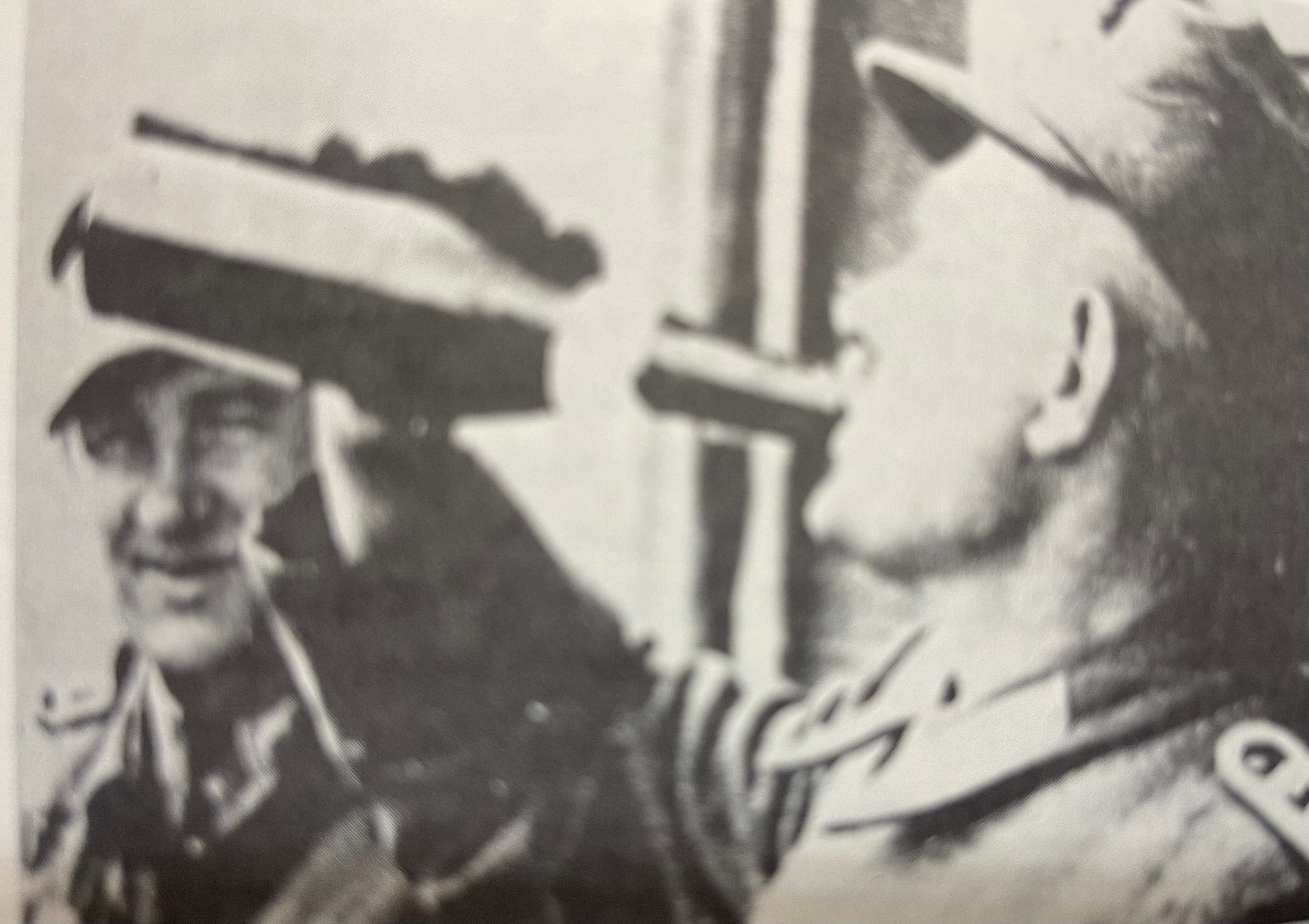
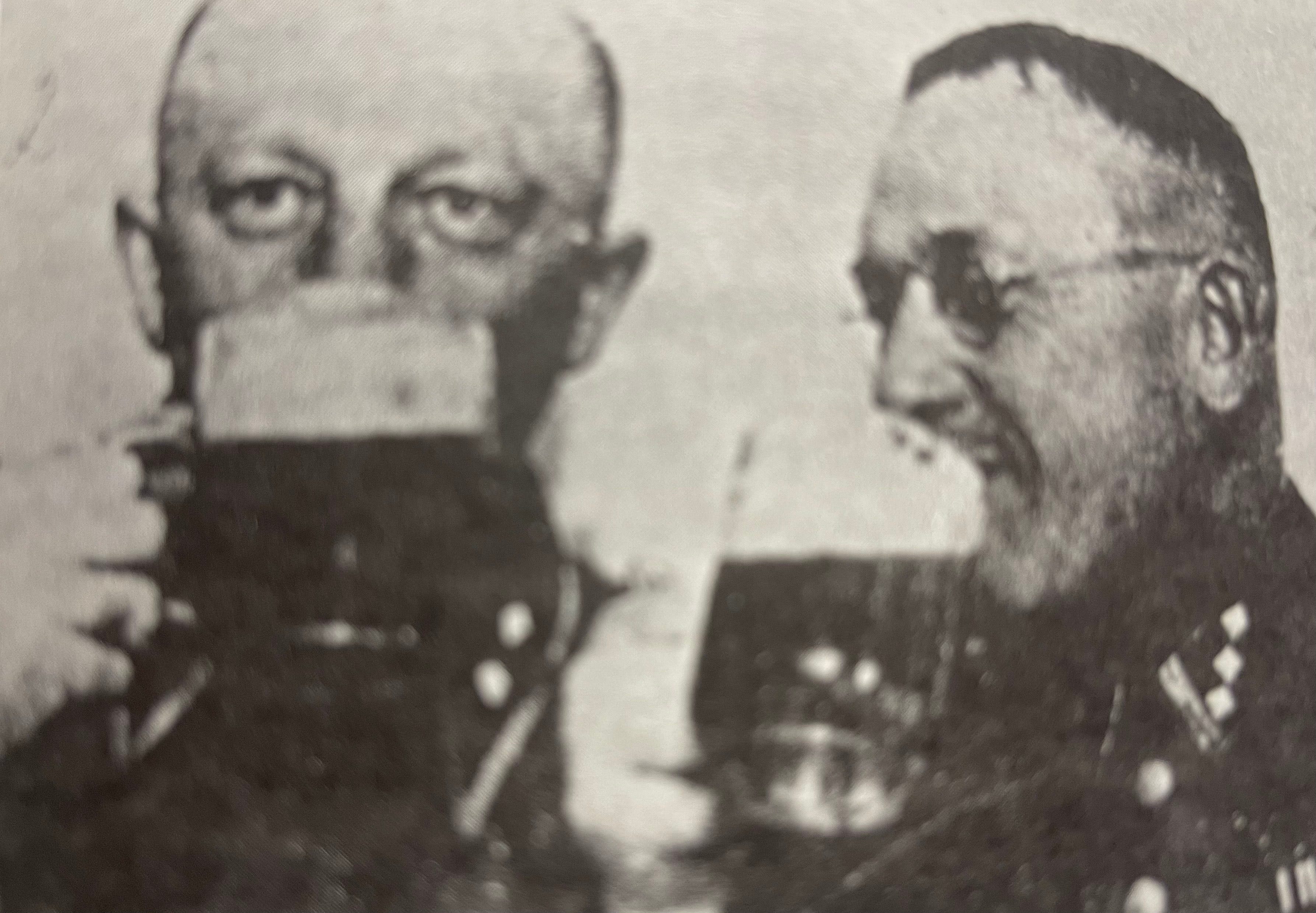
Klee’s book includes private letters, top-secret memos, myriad photographs by SS officers, and other documents on the best ways to “liquidate the Jews” and others, among other topics. In between photos of the killings, there are images, like the ones included in this essay, of the SS officers and guards enjoying leisurely activities, eating food, and drinking beer, schnapps, and other libations.
It reveals several things: first, how bystanders, especially in the East, took part in the mass killings, how soldiers and officers exposed their crimes to individuals back home in Germany, and what they wrote to themselves in their journals about the killings in which they were involved.
In Lithuania, a German military photographer wrote about a pogrom on June 24, 1942, in Kovno (Kaunas) near a petrol station:
The way to the road was completely blocked by a wall of people. I was confronted by the following scene: in the left corner of the yard there was a group of men aged bewteen thirty and fifty. There must have been forty to fifty of them. They were herded together and kept under guard by some civilians. The civilians can be seen in the pictures I took. A young man—he must have been a Lithuanian— . . . with rolled-up sleeves was armed with an iron crowbar. He dragged out one man at a time from the group and struck him with a crowbar with one or more blows on the back of his head. Within three-quarters of an hour he had beaten to death the entire group of forty-five people in this way. I took a series of photographs of the victims . . .
After the entire group was beaten to death, the young man put the crowbar to one side, fetched an accordian and went and stood on the mountain of corpses and played the Lithuanian national anthem . . . The behavior of the civilians present (women and children) was unbelievable. After each man had been killed they began to clap and when the national anthem started up they joined in singing and clapping. In the front row there were women with small children in their arms who stayed there right until the end of the whole proceedings (italics mine).1
Here is where the shock of the Holocaust and its participants comes into full view—in the front row, there were women with small children in their arms, as innocent men were bludgeoned to death. There are ongoing debates to this day about the role of bystanders during this brutal period of time, but in this case, these individuals do not appear to be cowed by the Nazis or repulsed by them. In fact, the locals are the ones doing the killing, as it is a Lithuanian man carrying out the executions in this eyewitness account. Klee also captures other instances in which Lithuanians, Latvians, Ukrainians, and others were willing participants in the near annihilation of Jews in those parts of Europe.
Letters sent back home also reveal the crimes the Nazis are committing in the East. Klee provides letters, for example, from SS-Obersturmführer Karl Kretschmer to his wife and children, in which he openly discusses seeing dead women and children, yet adds, “But we are fighting this war for the survival or non-survival of our people.”2 He explains that he is sure his wife understands, and writes, “As the war is in our opinion a Jewish war, the Jews are the first to feel it. Here in Russia, wherever the German soldier is, no Jew remains. You can imagine that at first I needed some time to get to grips with this. Please do not talk to Frau Kern about this.”3
Reading between the lines, Kretschmer is discussing the annihilation of Jewish people, and explains that it took him time to adjust to this fact. He’s also admonishing his wife not to speak to Frau Kern, who is presumably his wife’s friend, about what he is telling her in the letter.
Then there are the contradictory emotions expressed in private journals, such as Felix Landau. While in the East, he writes in one journal, “I felt acutely how attached one can become to another human being.” This entry, expressing how he feels about a woman named Trude, was written a day after he murdered numerous Jews. In the entries, he also writes about his love and “humanity” for her, while also speaking of lining up five hundred Jews to be shot. The entries reveal a calculating, callous man who seems to view mass murder as merely a “job,” and yet he is filled with tender emotion for a woman at home in Germany.
These mass murderers claimed they were simply “working for the state” or “serving the state,” as Kurt Möbius stated. He added, “I would also like to say that it never even entered my head that these orders could be wrong. Although I am aware that it is the duty of the police to protect the innocent, I was, however, at the time convinced that the Jewish people were not innocent but guilty. I believed all the propaganda that the Jews were criminals and subhuman [Untermenschen] and that they were the cause of Germany’s decline after the First World War.”4
“Serving the state,” “doing my job,” “fearing I would be killed if I didn’t carry out orders,” the latter comment was made often in 1945. Klee’s findings debunk that argument, as there are no cases in which any soldier faced death if they did not carry out orders to kill Jewish people. They were moved to a new assignment. Here, in this book, are absolutely damning pieces of evidence of how perpetrators were perfectly fine with how they murdered on a massive scale, how people, or bystanders, were fully aware, and even worse, willingly participated in the killings—a stunning, complex, impossible read, nevertheless a study worth one’s time.
Ernst Klee, The Good Old Days: The Holocaust as Seen by Its Perpetrators and Bystanders, eds. Willi Dressen and Volker Riess (Die Schöne Zeiten: Judenmord aus der Sicht der Täter und Gaffer (Old Saybrook, CT: Konecky & Konecky, 1988), 31-32.
Ibid., 163.
Ibid., 163.
Ibid., 220.
Thank you for this summary. Any such analysis affirms it takes an entire society to commit genocide.
The article is a public service piece.