
Unquenchable Thirst: Drinking from a River of Words

“We both step and do not step into the same river, we both are and are not”—Heraclitus (c. 540–480 BCE)

When I read that quote by Heraclitus in this moment, I think of how we are both the author and the reader (interestingly, I am also the author right now). Our beings, naturally, are very different: all of you, the authors, and I, the reader, that is, those of you I am to write about here in this essay. Intentionality gets muddled, just as a river is never always the same; a stream’s currents in prose are always in flux and ever-changing, just as Heraclitus was pointing out, much like traversing through life itself, what is read becomes seized by the reader’s own interpretation.
However, for many of us, when reading gives us an unquenchable thirst for unequivocally shared understanding, we drink from it again and again, still wanting more, like imbibing a fine wine. We, as readers, are always in search of these moments, that shared moment of truth. With each sip, as that fine wine deepens in its complexity, its tannins, exposed to the air, soften; it rewards our tongue and taste buds, momentarily enlightening our minds, just before that irreverent dullness sets in. As mentioned, we’re always in need of more of it. (After a long hike in the mountains, water can sometimes provide the same satisfaction, sans, of course, tannins and complexity, just the simple stillness of cold, clear water is enough, but we still must drink more, and the quiet dullness doesn’t follow.) There are innumerable books and essays, poetry and prose, that I could list in which I’ve found myself in a river of endless desire for that shared understanding of the knowledge being imparted to me, where I’ve returned again and again with a thirst to drink the words, to relive their verbs, their metaphors, their every moment. Ever changed, I go back again to find a new epiphany, a new beauty, a new pain, or a breakthrough, living in that moment of beingness with another. Yet the beautiful pain of it never being enough leaves an ineffable ache in my own being, one that never finds itself fully quenched. It is that lack of satiety that drives me to return again and also to seek out new opportunities to experience this unquenchable desire. It’s the profound apex of eureka, a fleeting assurance that, while rivers of understanding are never the same, you’ve suddenly crossed paths with the original author, and are, perhaps, momentarily standing in the same place they once stood in the conscious shared knowledge about a thing of which they’ve written.
In this piece, I’m going to dissect three pieces that were and are pinnacles of this praxis for me, as it is far from theoretical, since it affects me on a visceral level and compels me to act, to go back, and perhaps to thirst for an eternal return. The pieces are Sarah Kendzior’s “The Black Place,” Oliver Sacks’s “The Abyss,” and Johann Wolfgang von Goethe's Italian Journey (Italienische Reise).
Sarah Kendzior’s The Black Place
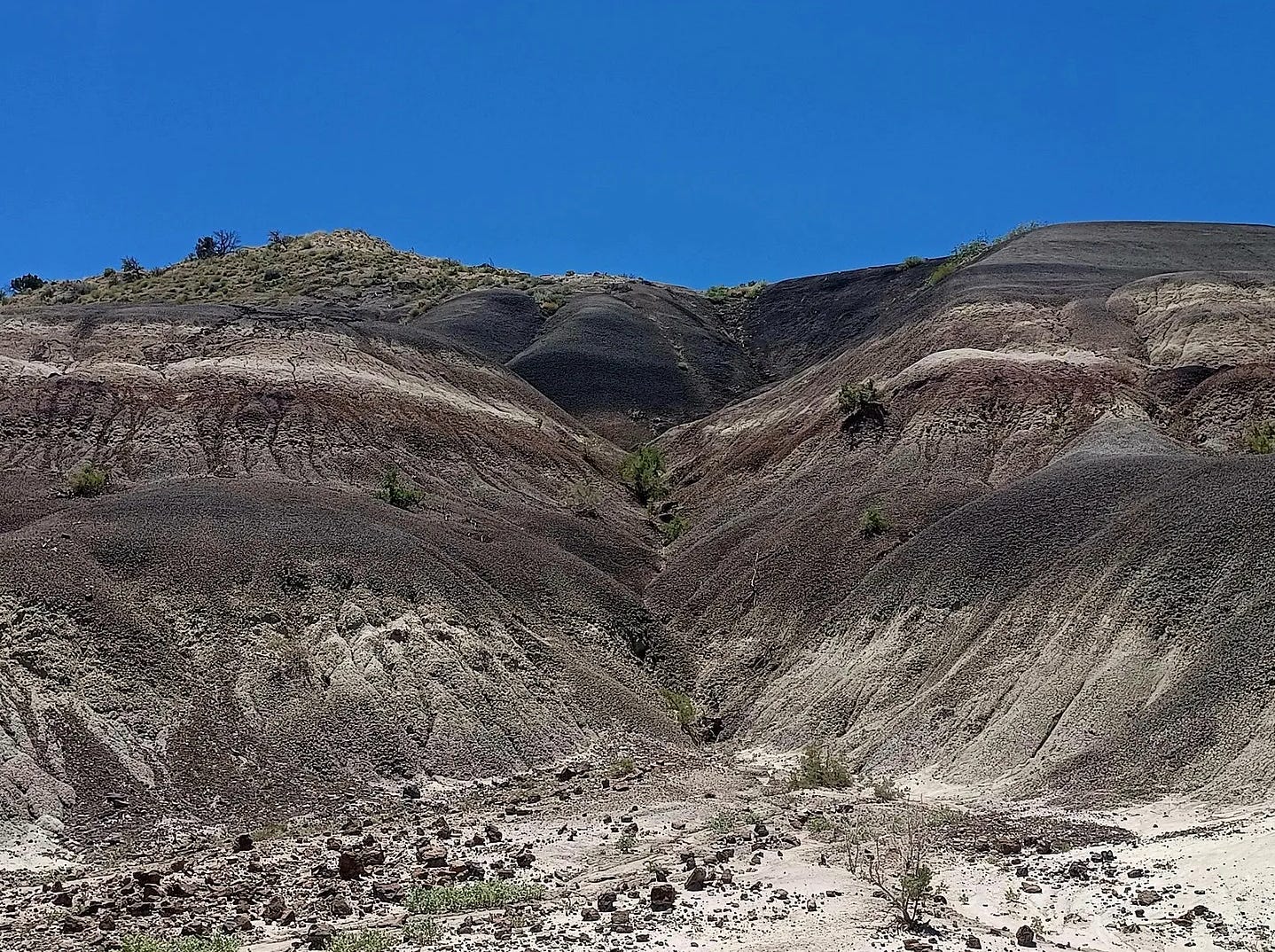
Sarah Kendzior’s remarkable piece, “The Black Place,” tells us a tale of her trip to a specific location, but if one is familiar with her work and her Cassandra-like warnings in her published writings as Trump arrived on the scene prior to his seizure of power, this place is also a personification of all that.
She opens by writing, “There are times I pass a mirror and don’t recognize myself. I got old too fast and saw too much. People think I’m younger than I am until they catch the look in my eye.” This is also a place where she visits alone, leaving her husband and son in an air-conditioned car, perhaps safely ensconced to protect them from what she knows she will see, a truth-teller who will bring back the bad news of The Black Place to them later when they are ready to hear about it. While she promises to be only 10 minutes in this place, she ends up being gone for an hour, as time loses its meaning in this location, just as time under a fascist regime becomes meaningless, the now is what matters; the past and future are squelched, they are neither here nor there. Under fascism, we are not able to fully examine the past, and the future is either bleak or non-existent, lacking possibility and certainly hope.
When Kendzior returns from The Black Place, she goes to Cortez and buys a Navajo rug. Kendzior writes:
It has a seam on the border called a ch’ihónít’i, or spirit line. The spirit line protects the weaver from the emotions of the person who bought it. The artist wove herself an exit from her creation.
I look at my rug and am grateful the woman who wove this beauty is spared my thoughts. I feel longing for the West — and the lonesome embrace of The Black Place.
This lonesome embrace of The Black Place enables Kendzior to share her wisdom and insights with the rest of us, if only most of us were willing to listen.
But beyond being a personification of fascism and Kendzior’s incisive wisdom about its impending threat, The Black Place is also a sacred site of meaning that risks destruction by the U.S. government, as it sits on public land, Kendzior notes.
One of the most famous visitors to The Black Place was Georgia O’Keeffe. When O’Keeffe settled into New Mexico, Kendzior tells us she drove over 150 miles to find the right place to paint, and it was The Black Place. At first, she called the area, “The Far Away,” but eventually she named her paintings, “The Black Place.”
There is a somber, enthralling beauty to Kendzior’s writing about The Black Place, mournfully visiting this location, pondering all that has come afterward. And here we are now (at the time, she published it in 2025, but the essay still resonates in 2026). Perhaps that grief and mournfulness have shifted towards a collective rage, yet many still now speak in tones that remind one of being in a universal funeral parlor, much like the tone of Kendzior’s own works.
Interestingly, Kendzior actually wrote “The Black Place” in 2024, held onto it, hoping she’d be wrong, but she wasn’t, like usual. She explains:
No one enjoys watching their worst forecasts come to fruition and then be asked to rehash them after it’s too late. I wanted something akin to a spirit line to protect you from the future I saw coming. I wanted to protect myself too.
Kendzior clearly says here that she takes no pleasure in being assigned the role of Cassandra. It’s a taxing job, one that resonates with me as well. But here she is now and then, pushing back against the fascism that seeks to deny us all a past and a present, which she insists on preserving, while providing suggestions for a better future. Indeed, her tapestry-layered prose of truth fights for the public good, and because of that, I return to her work to try to quench my unquenchable thirst.
Oliver Sacks’ “The Abyss”
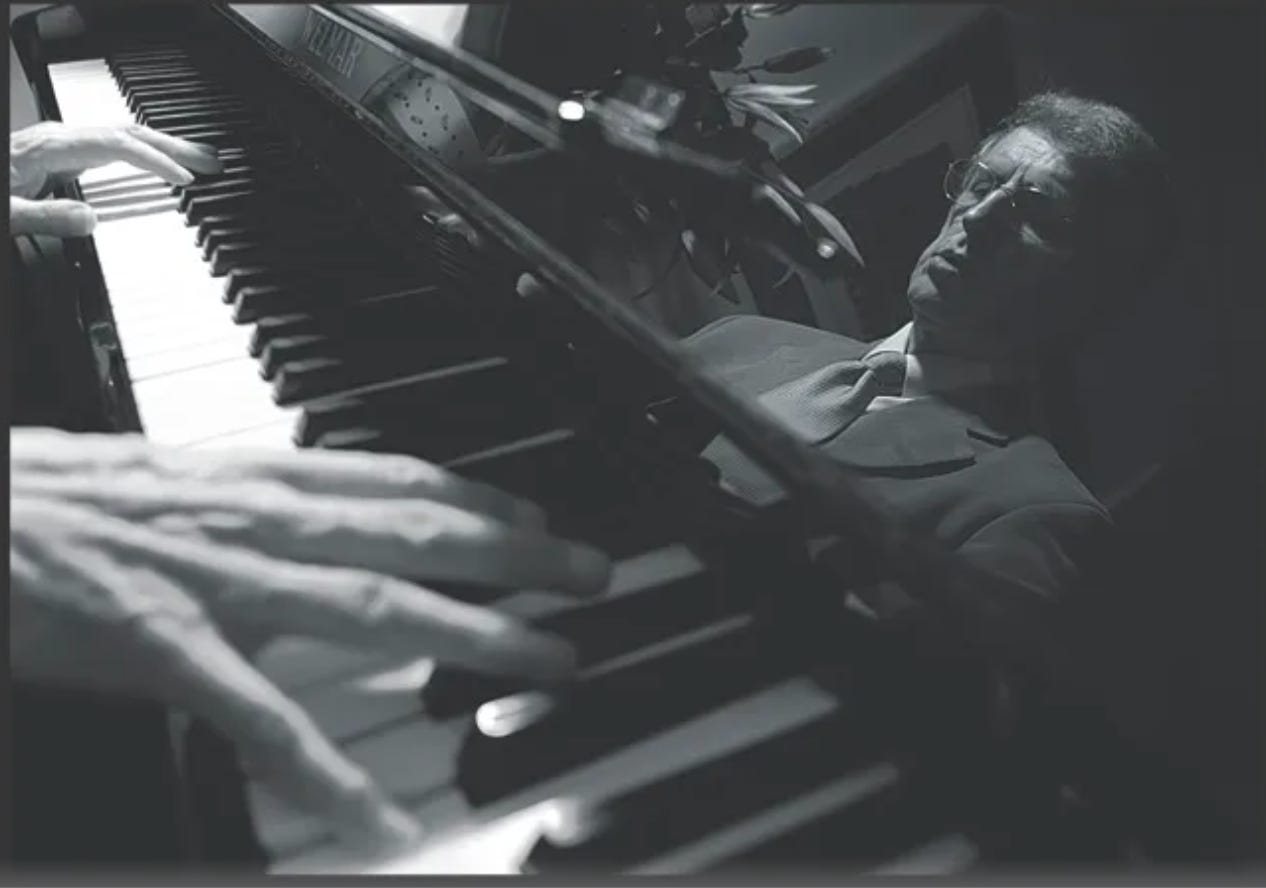
Clive Wearing (1938- ) was a well-known and highly respected English musicologist and musician. In March of 1985, when he was only in his mid-forties, he developed herpes encephalitis. As a result, he lost his short-term memory, possessing only 7 seconds of it at a time—his amnesic case is still one of the worst known globally. Olive Sacks draws us into a profoundly deep world of consciousness, forgetting, language, and music through the complex lens of reading itself when telling us Wearing’s tale. Not only did Wearing have only seconds of his life to recall at a time, but he also had what is called “retrograde amnesia,” meaning, as Sacks describes, “a deletion of virtually his entire past.”
In 1986, he was filmed for the documentary “Prisoner of Consciousness” by Jonathan Miller. In this film, Wearing is alone, frustrated, and also consciously aware that he was “being deprived, in some uncanny and terrible way, of all experience, deprived of consciousness and life itself.” In a word, he was a walking dead man.
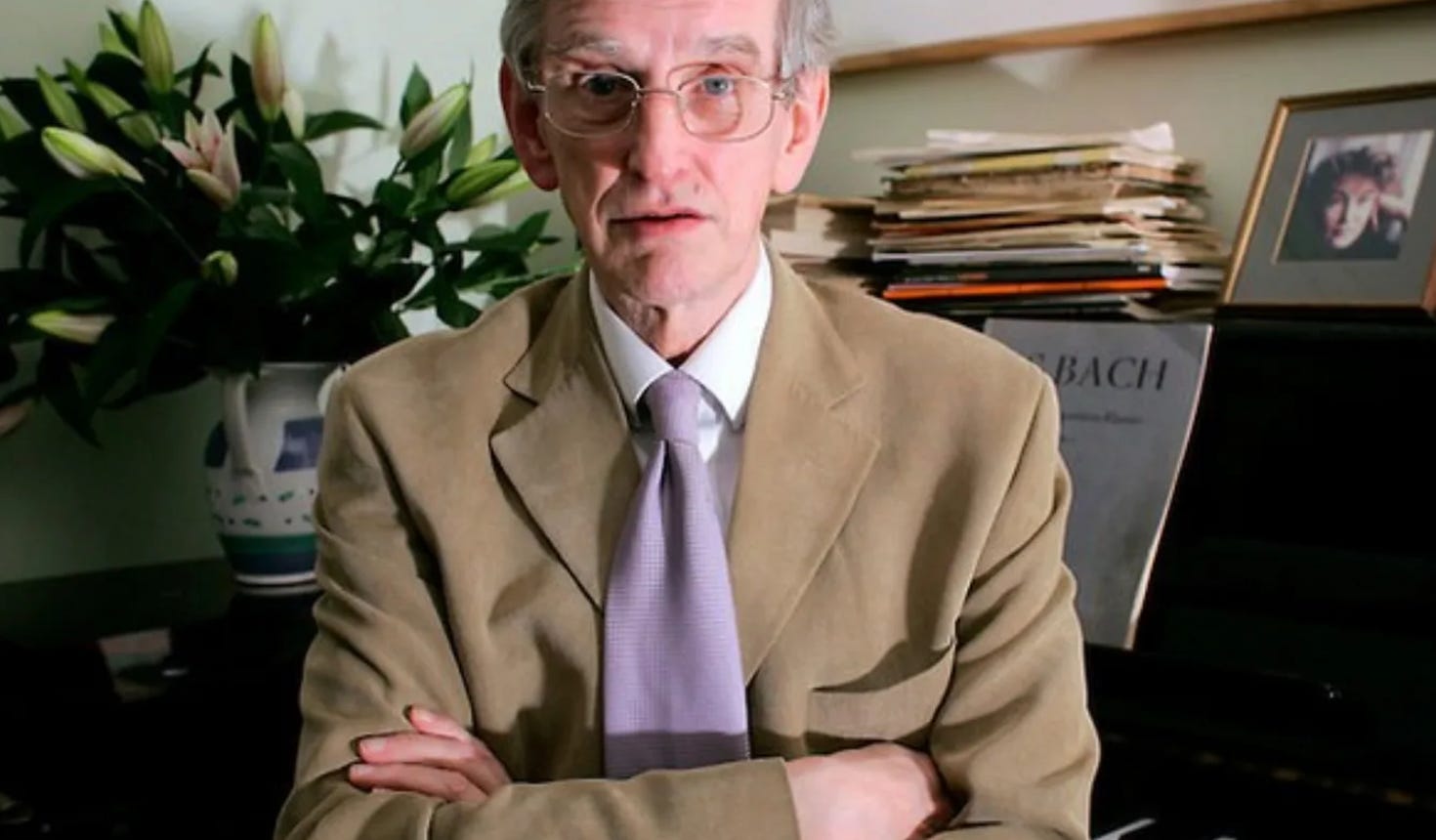
In the Sacks piece, “The Abyss,” his wife said he would tell her, “It’s like being dead.” (His wife, Debra Wearing, was, miraculously and strangely, the only person he recognized after he lost his short-term and long-term memory.)
Wearing began to keep a journal of his experiences with this extreme form of amnesia, and the entries are agonizingly painful to read. Sacks deftly captures them here, in which Wearing would write things like:
“I am awake” or “I am conscious,” entered again and again every few minutes. He would [also] write: “2:10 P.M: This time properly awake. . . . 2:14 P.M: this time finally awake. . . . 2:35 P.M: this time completely awake,” along with negations of these statements: “At 9:40 P.M. I awoke for the first time, despite my previous claims.” This in turn was crossed out, followed by “I was fully conscious at 10:35 P.M., and awake for the first time in many, many weeks.”
Despite the gravity of the situation, the “lostness,” as Sacks describes Wearing’s mental state, one is gripped by the tale, the way in which Wearing’s consciousness fights to recall who he is, where he is, what life itself means without memory—the writer has lured us into every detail he’s captured, but more than that, he’s delving into our own notions of consciousness, he’s raising questions about our own ability to remember, to recall memories, and to be in this world.
Johanns Wolfgang von Goethe’s Italian Journey (Italienische Reise)
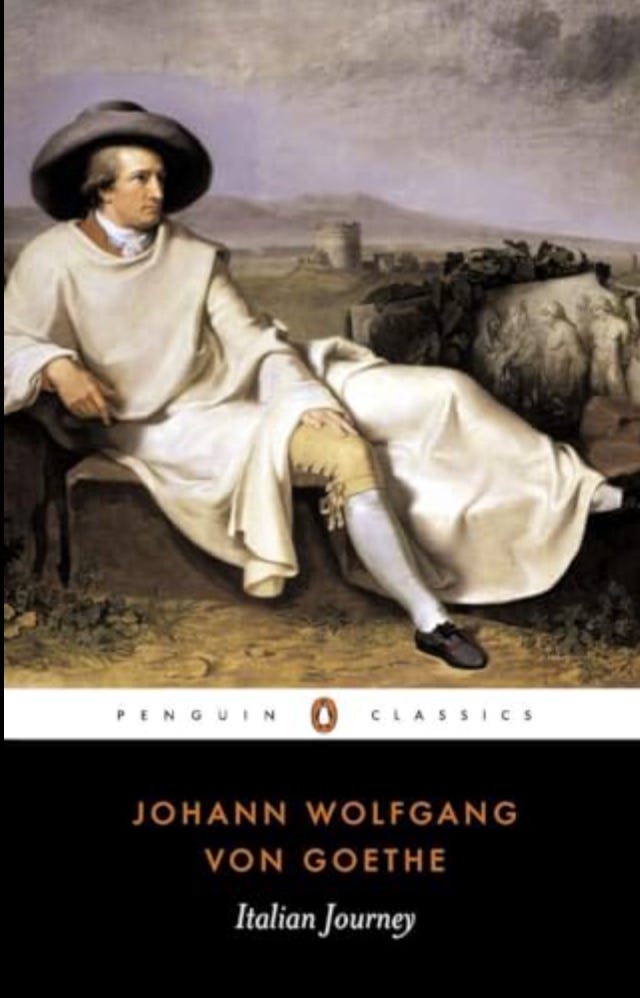
Incandescent light, found only in Italy and captured by the Italian Renaissance painters, straight, elegant cypress trees standing starkly against mountains, wine groves, lakes, or fields. These are the images that Johann Wolfgang von Goethe (1749 - 1832) accounts for in his Italian Journey in 1786. But he does more than that in this study that he wrote. More on that in a moment.
I also took this same journey several decades ago after studying German in München (Munich), Germany, at a Goethe Institut. With Goethe’s Italian Journey in hand back then, I took my own journey throughout Italy (I have since returned multiple times), but I have also picked it up again and, for this essay, dove into its rich descriptions of Italy and the personality types that emerged from the urban and cultural centers of power that Italy once had.
In the early stages of his arrival in Italy, we find Goethe in Trento. It is here he writes and aptly captures the sheer enormity of Italy’s natural beauty as he describes the scenery:
[A] few clouds can be seen resting on the mountains, standing on the sky rather than drifting across it, or when immediately after sunset, the loud shrill crickets is heard, I feel at home in the world, neither a stranger nor an exile. I enjoy everything as if I had been born and bred here and had just returned from a whaling expedition to Greenland.1
Right in this moment, I can see those very clouds standing on the sky above the mountains in Trento, as Goethe describes them. And Goethe feels at home in the vastness of this nature, the massive clouds on the enormous mountains. The sound of high-pitched crickets, singing their nightly songs. Goethe is telling us he is one with Nature in this moment, something that has become much harder for many of us in the Global North to experience. Yet, when I was in Italy, in Sicily in particular, I had similar experiences to Goethe while basking in the sun, whose light only hits the cypress and olive trees and old, clay buildings in a certain way there. It’s captured in centuries’ worth of paintings, too.
Later, Goethe goes to Venezia. I can also recall my own traveling by train from Germany first to Venezia, the city of mysticism, canals, and the Doge ruling over it in the 16th century. When Goethe arrives in Venice, he explains:
So much has been said and written about Venice already that I do not want to describe it too minutely. I shall only give my immediate impression… Houses were crowded closer and closer together, sand and swamp transformed into solid pavement. The houses grew upward like closely planted trees and were forced to make up in height for what they were denied in width… The place of street and sqaure and promenade was taken by water. In consequence, the Venetian was bound to develop into a new kind of creature, and that is why, too, Venice can only be compared to itself.2
Here, Goethe hits upon something key about space, location, and the peculiar urban development of Venezia: that of a particular type of personality that emerged as a result. He does not delve further into what this means, but it enables us to ponder the meaning behind the ways in which complex, historically-laden cities, such as Venezia, influence the development of personality types.
As one can immediately grasp, Goethe’s Italian Journey is not simply a description of what he sees in the land, but also in its people and its rich, complicated history. It is a text worth returning to over and over again, and when I return to Italy, I will certainly be taking it with me.
Conclusion
It is always a joy to return to the works of other writers and reread their works, identify with them, and feel as if one is, in the very least, gliding across the river where they once walked in the words they’ve put down on their pages. While such prose leaves that teasing, unquenchable thirst, again, it’s like a fine, aging wine that invites you back for yet another taste. Kendzior’s work is almost always mournful, filled with red flags, and intense to read, yet symbolically beautiful, insightful, and informative. Sacks’s work on the amnesiac Clive Wearing makes me think about the very concept of consciousness, the possibility of existing without memory, and humanity itself. Goethe’s Italian Journey inspires me to think about the way in which different topographies, urban development, and culture created personality types at one point in time in Italy. It’s also a delightful travel companion when visiting Italy. Nothing is better than having a brilliant mind like Goethe’s by your side when on vacation—the gift of his observations is immeasurable. This essay is now a reminder that although I have a pile of new books waiting for me to read, I have a library of previously read ones that are patiently waiting for my return.
Johann Wolfgang von Goethe, Italian Journey, trans W.H. Auden and Elizabeth Mayer (Penguin Books, 1962), 39.
Ibid., 225.
Excellent reviews from revisiting your favorites.
All were good but The Abyss review stuck with me the most. As a Black person in the Western hemisphere, our history and its accuracy was and is a struggle to obtain. The same way herpes encephalitis stole, and continues to steal Wearing's memories and personal history, is akin to white supremacy hiding or distorting Black people's history, prior to abduction to western plantations, during enslavement and after emancipation. As Black people fight to regain, preserve and share as accurate a history of themselves as possible, white supremacist structures take, hide away and invent distortions instead.
Great reviews.
This is lovely, Cryn.
Thank you.