
Split from the Body: Disembodied Writing
Technology Has Not Helped Us Become Better Writers

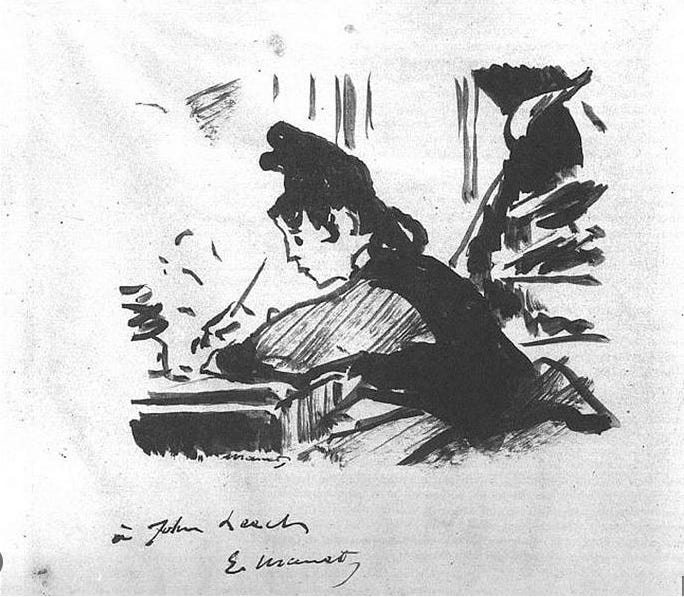
My brother knew how to write in cursive before I did. He was four years ahead of me in school, and I remember jealously knowing that he had begun learning cursive when I was in kindergarten. Meanwhile, I was arduously drafting on paper, my first a’s, b’s, c’s, and d’s in wide, large lines in notebooks handed out to all of us kindergartners at Leawood Elementary School in Kansas.
Eventually, I made it to the third grade, where, like my brother, I, too, received new notebooks to learn cursive. Like most third graders in the United States, our class was taught the art of cursive writing, something I personally beamed with pride in knowing how to do. This was also when I began keeping a journal, something I’ve done ever since. Although I can’t recall now if I wrote in cursive when I first started journaling, I’m confident, given how proud I was to be able to write in cursive, that I most likely did. My later journals are not in cursive; they are in plain, non-cursive script, and remain that way today. I also do not journal as much as I once did. At one point, I used to write a journal entry every single day—I have a library of journals that go back to when I was 12. Now, I’m lucky to write an entry once a month, and you can tell how much my handwriting has degraded by looking at them.
In college, I quickly learned the art of shorthand, which served me well once I began doing freelance journalism, as I was able at one point to capture almost every word spoken when I interviewed people, not so much these days. Instead, I rely on the keyboard to catch words from people I interview. It makes me wonder how much I’m even absorbing, compared to the notes I took in college and graduate school, too (more on that in a moment).
For quite some time, I used to scoff when my mother complained about how children no longer learn cursive. I found it antiquated, unnecessary, silly. But ever since I’ve tried to recommit myself to writing a new journal, I’ve suddenly realized she is not wrong. We have been robbed of something, now that we all write by keyboard.
After reading the 1,000-page journal of Victor Klemperer this past summer (you can read the lengthy reviews I wrote up about it here and here), I decided it was important to start notating my life again by pen, but instead of just focusing on my interiority and psychology, I needed also to incorporate exterior elements that were affecting my life, i.e., global politics, Trump, etc. (I won’t go into specifics but Trump has played a significant role in shaping the outcome of my life these past few years—it’s truly wild.) That’s when I took up journaling again and found myself struggling to write with a pen.
We have become disembodied from our thinking, our sense of physical oneness with the act of writing itself. The act of typing on this blank page has separated me from the physical act of writing my thoughts down with a pen in my hand. In short, technology—that of the computer, the keyboard itself—stifles the creativity that comes from holding a pen in hand. One may come back at me and argue: “Well, what about the typewriter? How is that different from the computer?” I would wager, in fact, that they are pretty different. The typewriter is still more like a pen, the way it clickity-clacks under your fingers (here, again, I am giving away my age, although I mostly grew up writing papers on a computer). In contrast, the softness of the keys on a computer and the way one’s thoughts appear on a white screen create a separation from the body and the physicality of what’s being made from one’s mind. (There is also the aspect of resetting the ribbon on the typewriter, and then watching, as I said, the clickity-clack of each letter stamp itself on the paper, as you think through what you’re writing, the thoughts bleeding out into little black letters as you physically punch each letter on the typewriter’s keyboard.)
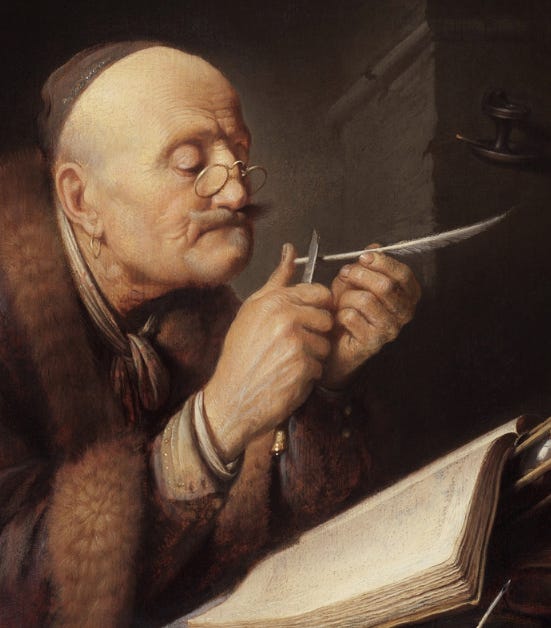
At the end of the day, however, the most powerful way in which to write is with the pen. It is held directly in the hand, gripped by the body's muscles and tendons, the brain receiving every signal to carry out those actions. One also doesn’t have technology informing you of misspelled words, or, in the case of AI, wrong phrases, suggestions on how to change this or that saying, etc. It’s just you, the pen in hand, and your mind. (The typewriter, of course, is a good second option.)
Does this suggest I will abandon the computer and the keyboard? No, it does not. But it does mean that I know that these things have made us lose something critical, something that could be regained if we decided either individually or even collectively to walk away from these creations that have not advanced us, but actually torn us away from our imaginations, our intellects, our better forms of ourselves, and how we could think about the world.
For now, I’m walking away from this screen and this keyboard, picking up a book, and later I will write in my journal, exercise my hand and my mind together, and ponder things a bit more deeply.
Excellent post, Cryn. I love using a fountain pen, but I’ve realized—much to my disappointment—that I’ve nearly lost the ability to write in cursive.
Great work, thought-provoking. The mind-blowing question for me, through many years of keyboards and writing by hand, is "why" the difference exists between mediums. My mother was practically a savant at predicting things, and out of the blue, in 3rd grade, she made me spend a summer learning how to type on her Selectric. It wasn't to punish. (read: circa 1976, and I was not happy with her dictation (meaning 2)).
She made me do it because she knew the utility of typing would increase exponentially as computers took over business. I freak people out sometimes because my chat responses are almost too fast. It's not a fact I'm proud of.
My reflective thought: The mindful presence required to write reveals a deeper answer to why I choose to ditch the keyboard and pick up a pen quite frequently these days. It's to slow ideas down and elongate them into fully formed structures before committing the one-way act of putting pen to paper. Sure, I can and do scratch out whole sections of garbage - I'm an equal opportunity idiot when it comes to my thinking. It's the effort required to think before acting, which I find I'm more inclined to do when disciplining myself to write a full set of ideas down on paper. Discipline builds mental muscle, and as I age and my memory deteriorates, I find it compelling to do what I can to slow the process.
I appreciate your observations and thoughts, Cryn. You provide insightful, tangential, and central questions and ideas. They're one of a kind, and thank you for your composition! Excellent!