
Emil Ludwig's Study on Dictators
Is there any value in interviewing living monsters?

INTRODUCTION
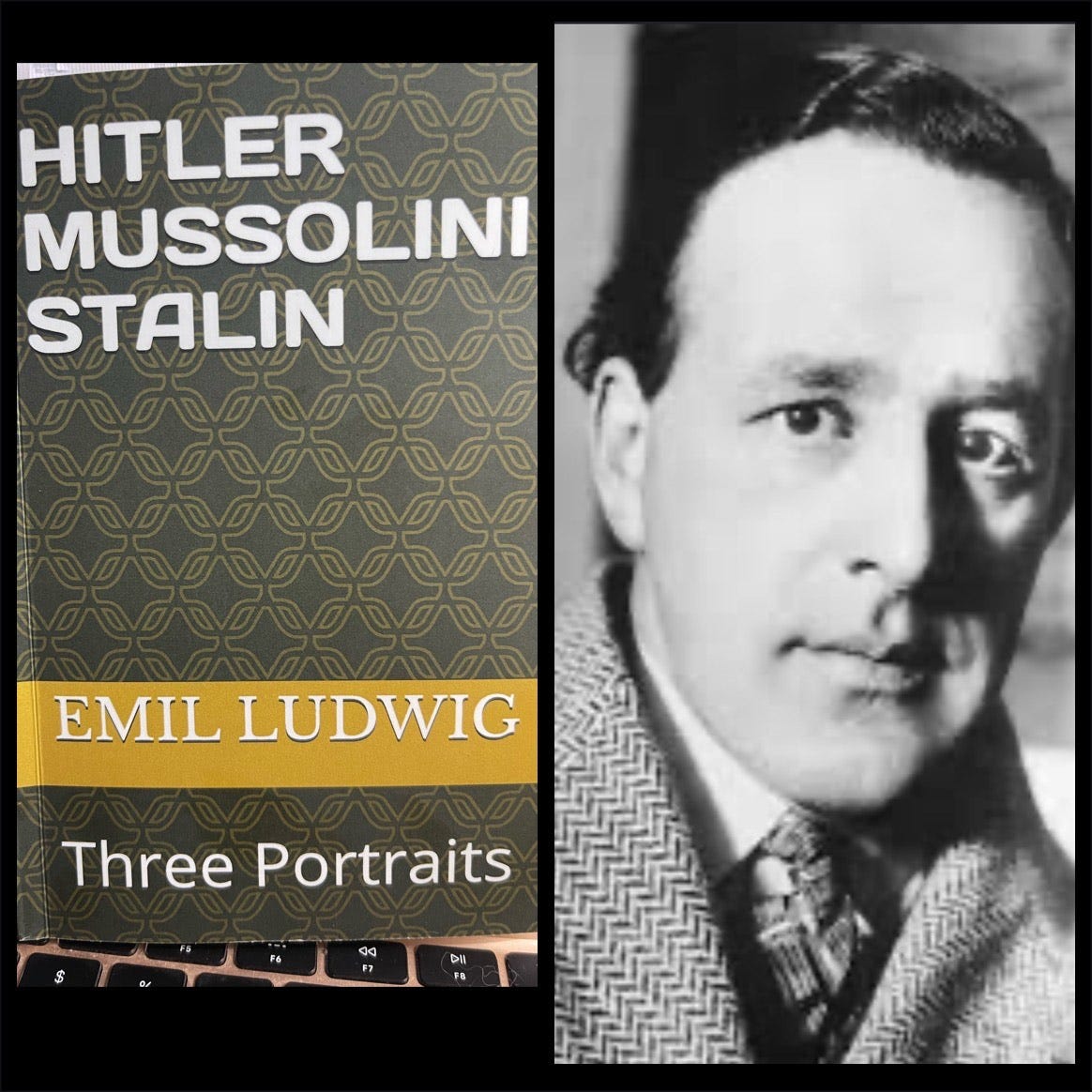
A man of many writing talents, German-Swiss Emil Ludwig’s (1881 - 1948) legacy is that of biographies. In 1940, he wrote three short, pithy, psychological pieces on Adolf Hitler, Benito Mussolini, and Josef Stalin (he sat down with “Il Duce” and “Koba”). These three men, all of whom left indelible and horrific marks on world history in the twentieth century, are not easy to capture in the human sense. Where does one begin to describe each tyrant? How does one simply “sit down” with a man like Mussolini or Stalin to talk? What’s it like to prepare for such meetings? Did sitting down with them mean Ludwig really grasped them as men?
Ludwig made it clear that he found each man more than disagreeable. In the forward, he writes, “I am against all three, because they are all against freedom”(5). But he insists, like everyone during that time — and still to this day — their personages are intriguing, hence the reason to write about all three men. Many of Ludwig’s sentiments are also now anachronistic, and his exposé on each man raises moral questions about the value of interviewing dictators, so the reader of this review must determine whether or not his short book is worth reading.
HITLER
With a dictator surrounded by such mystery and a negative aura, it seems — even at the time Ludwig wrote about him — an almost insurmountable task to capture the man Hitler. Yet in a few short pages, Ludwig seemingly manages to tackle what, to many, does feel impossible. Despite never sitting down with Hitler, Ludwig attempts to bring him to a human level, one quite pathetic to boot. While he conveys Hitler’s failure as an artist, a well-known fact about him, he also tries to portray his inconsistent, irrational, megolmanianical idiosyncrasies in great detail. One sees the ranting orator (we can view this visual fact in the thousands of hours of film we have now of Hitler). But Ludwig also tries to convey an inconsequential, anxious, perfidious man, concerned with trifling matters and obsessed with the need for attention. As Ludwig notes, “Hitler wants what actors want — continuous applause, and applause, moreover, from every living being” (29). (He was also a country bunkin. Hitler removed himself from cosmopolitan Berlin to a kitschy cabin in the Bavarian Alps, where he did not rise until 10 in the morning.) Indeed, his daily activities in his hokily-designed cabin are best described as a man obsessed with having the following: a perpetually fawning, sycophantic audience, distracting entertainment, and the attention of women. Ludwig explains:
His amusements are the cinema, where he may sit through three films on a single evening, and the vists of film actors and actresses, to whom he talks for whole evenings of his frustrated passion — art. His few affairs with women have all come to a sudden end (26).
One such “affair” with a woman, prior to Eva Braun, ends disastrously. That was with his niece Angela Raubal, a young woman he took complete control of, practically imprisoning her in Munich in 1931. When he forbade her to leave one night, she wound up dead, shot to death, in her room. She was only 23. (27)
Hitler also did not read, just like the uneducated, aside from the newspapers. Ludwig writes, “In all of the six hundred pages of his own book, there is not a single quotation from a German author; he knows none” (28). (And yet the Germans offer us great writers and philosophers, but Hitler couldn’t manage to read any of them!)
So, tucked away in his corny Bavarian villa, Hitler watched movies, whiled away the time with actors, complained about his failure to become an artist, and lectured his uniformed men with his nose in Zeitungen that only praised him.
Germany and its people, of course, are also to blame for the rise of Hitler, according to Ludwig. (So were its neighboring countries.) The German people were weak and prone to fall for a man of his oratory skills, which Ludwig does give him credit for. When he seized power, killed his political rivals, “[the Germans] looked on with horror while a gang of lawless barbarians wrought havoc about them” (23). The former constitutional State, the Weimar Republic, was shattered. But, as noted, that was the doing of the German people. “For they did not inherit this man,” Ludwig writes, “but repeatedly elected him” (32). He continues:
[E]ven though millions of them did so under compulsion, still more millions worshipped him, and the intellectual leaders of the country were at once on his side. Only a handful of writers and artists resolutely opposed him from the very first day. They are now beyond the German frontiers. It was an honor for the present writer to have his books burned in the great public burning of May 1933 (32).
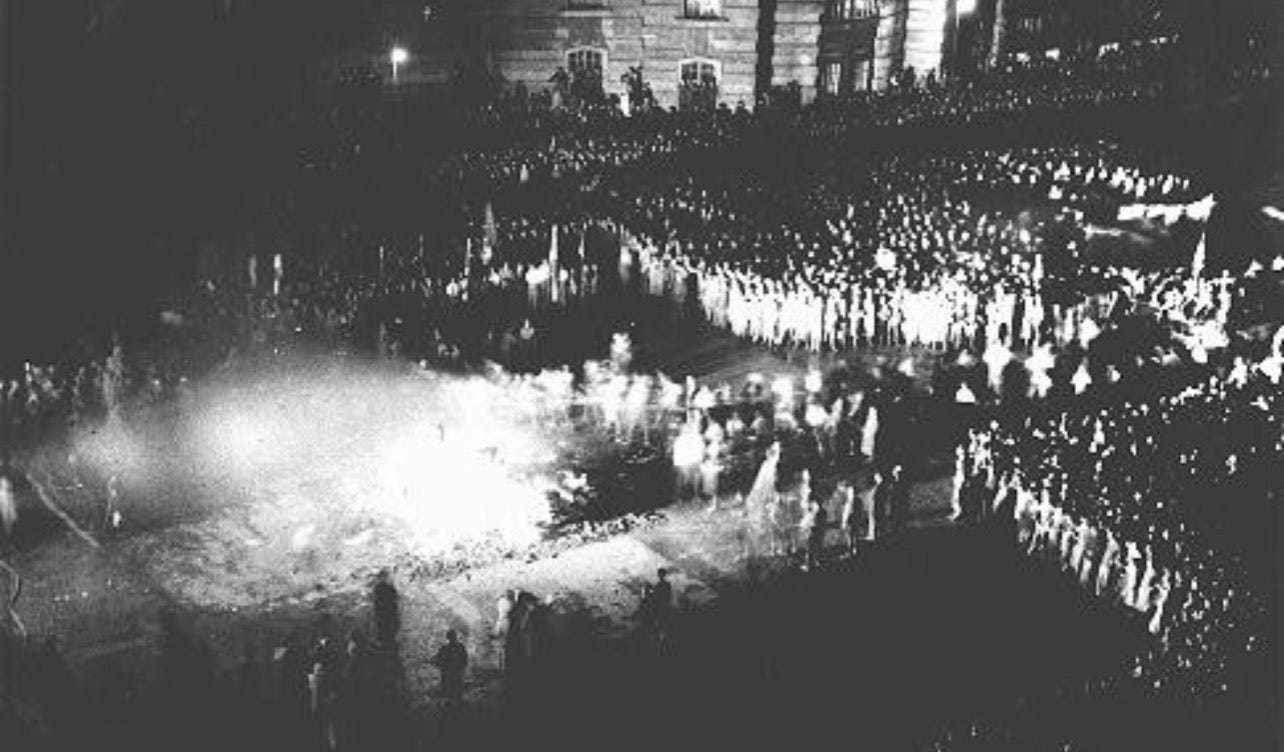
Nazi Book Burning in Berlin, 10 May 1933 (Credit: World Wide Photo)
Ludwig sees the divide as being that between “intellect” and “government,” something that “distinguished Germany from all other civilized countries for the last four hundred years (32).” There are their great thinkers and musicians (Immanuel Kant, Johann von Wolfgang Goethe, George Frideric Handel, Johann Sebastian Bach, etc.), but they did not influence the State (32). In addition, aside from Kant and Gotthold Ephraim Lessing, Prussia itself did not create these artists, plus the two philosophers were “passionately hostile to the Prussian spirit” (33).
The State was also run by a small “caste,” an aristocracy, leading up to World War I. Germany’s middle class was resigned to this caste system, begrudingly accepting its domination. As a result, Ludwig argues, “Germans have never known freedom” (33). Once World War I ended, they longed for revenge after defeat. Hitler stepped into the right moment and seized the zeitgeist.
Hence, there is but one solution to how Germany should be dealt with: divide the country up again. As he notes, “Goethe declared that German culture was possible only because there was not one capital, but half a dozen” (34).
To defeat Germany, an invasion is necessary, too, for four “psychological factors.” First, the Germans have been anxious for seven years. That is not the case with the Allies; rather, it is quite the opposite. Second, for over 125 years, Germans have not faced enemies on their land; an invasion would cause tremendous trauma to the collective psyche. Third, Germans at the time had been fed propaganda that democracies lacked power; a show of force would catch them off guard. Finally, the adoration for Hitler would be annihilated after defeat, which would then lead to collective resistance and outright revolt within the country.
MUSSOLINI
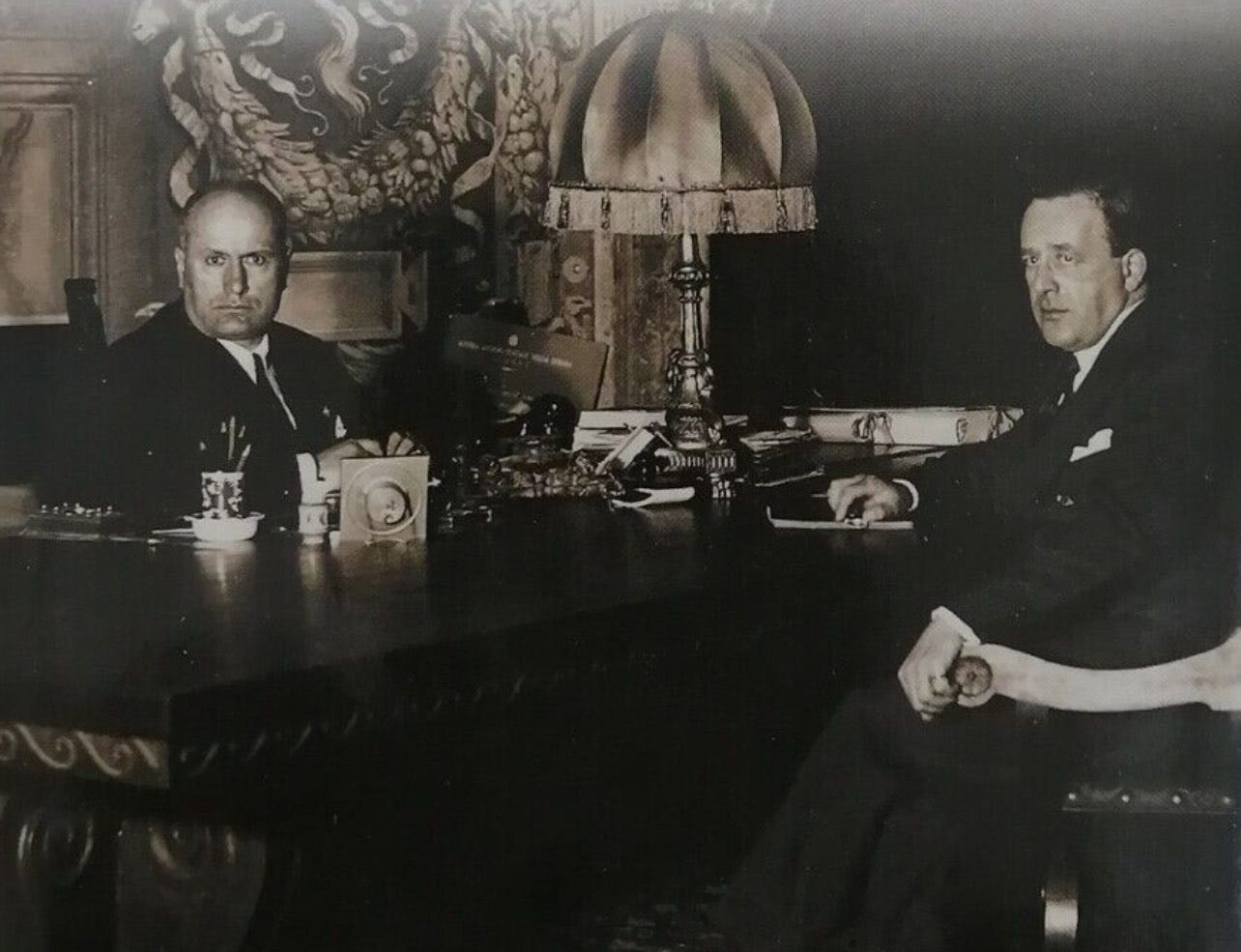
Mussolini with Ludwig in the Room of Maps of the World at the Palazzo Venetia (photo source found here)
In the opening to Ludwig’s essay on Mussolini, he is quick to defend his meeting with him by discussing how he and the other two dictators are “[determining] the history of today.” He adds:
Only the stupid despise a leader because he represents a doctrine they dislike or hate. If I, as a resolute opponent of fascism, had refused to approach the dictators, I should lack the most solid basis of comprehending motives, and hence should be unable to foresee what their future action will be. Since I have done nothing for the last thirty years but study at first hand the human heart, the characters of nations and their leaders, I have been able to predict in books and lectures the main outline of the events of the last few months for seven years past, and find today only trifling errors in detail (37).
Here, he placates himself by defensively asserting that his work is almost like a crystal ball. Despite the closeness to outcomes that he “foresees,” Ludwig also seems to be hedging his bets in the soft conclusions he draws, making it easier to proclaim later, after the events unfolded: “Aha! See! I was right after all!” This stance allows him to skirt the moral and ethical questions raised about sitting down with tyrants, which, as we are aware, is what he did.
As previously mentioned, and as seen above in this photo, unlike Hitler, Ludwig was able to sit down with Mussolini for interviews with him. Knowing this fact makes it at least possible (or does it not?) to envision Mussolini as a man more easily than that of Hitler. At first glance, he does not seem as much like a historical apparition, a ghoulish, yet murderous phantasm such as Hitler, given that Ludwig saw him in the flesh inside a Venetian Palazzo. (Ludwig also indicates that he encountered Mussolini as early as 1928.) But is that true? Do we gain any insight into Mussolini from how Ludwig writes about their interactions?
Ludwig makes it clear that he holds Mussolini in particular esteem (“I have no hesitation in declaring him to be the most interesting statesman I have met in Europe”). He even goes so far as to say that his face is superior to those of his allies and his enemies. Ludwig continues describing his visage at length, saying at one point, “at twenty [Mussolini] has the glowing eyes of a fanatic, of a poet” (38).
Behind that superior-looking face is a thinking mind, something which Ludwig does not grant to Hitler. Ludwig explains, “he studied the poets, Shakespeare and Nietzsche, and read D’Annunzio ... with passion. And above all — history. His father used to read Machiavelli aloud by the smithy fire to his friends and the boys. That is not a legend. Mussolini told me so himself” (39).
Here, Ludwig takes Mussolini’s word about this familial story. Did Mussolini’s father read Machiavelli to him as a child? Or is Mussolini propagating an image of himself and his childhood to reflect his erudition? How do we know that he isn’t manipulating Ludwig, just as he manipulates the Italian crowds when he speaks from his balcony? Ludwig seems to readily accept much of what Mussolini tells him, but, then again, he has a begrudging respect for him, unlike his sentiments towards Hitler.
To Ludwig’s credit, he does confront Mussolini about the assassination of Giacomo Matteotti. (There is still speculation that Mussolini was involved in his death.) Il Duce still manages to wiggle himself out of this seemingly uncomfortable question, saying, “Political crimes are just as frequent in the democratic states. Under Napoleon III and in the French Republic there were plenty of mysterious cases, and there have been more murders in the new Germany [1932] than in any other country” (45). Ludwig does not follow up on this remark, but instead insists that Il Duce is far craftier as a statesman than Hitler to the North.
Ludwig makes one thing clear and accurately concludes: if Mussolini continues to align himself with Hitler, he is most likely doomed, which turned out to be the case. As Ludwig writes, “If he plunges into his imitator’s adventure, he will perish with him. If he refrains, it will be seen how superior he was to him in statesmanship” (57).
STALIN
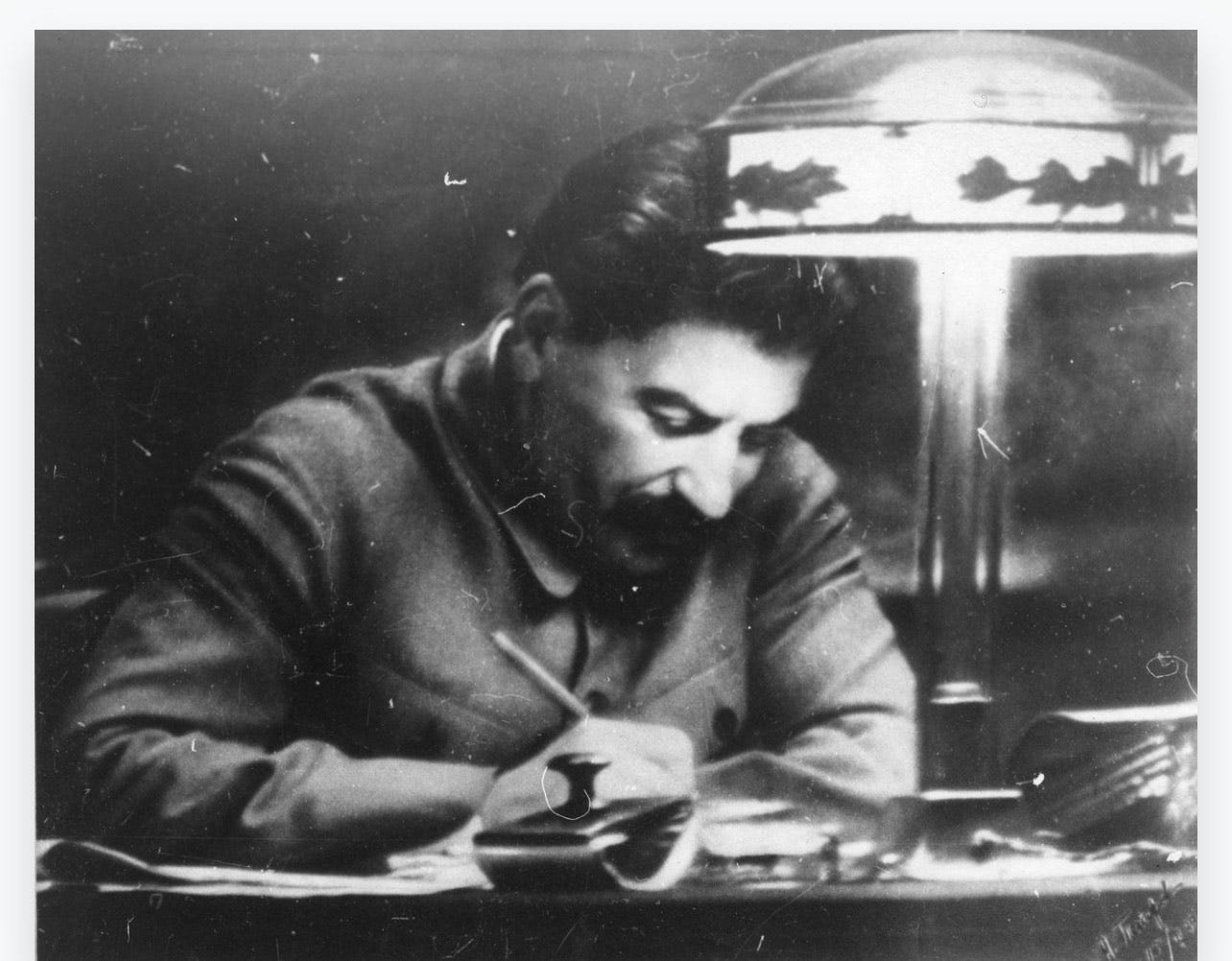
Stalin sits at his desk (Photo Credit: unknown)
When Ludwig encounters Stalin in a drab, yet well-lit room in an annex of the Kremlin, the dictator and he sit at a large conference table together. Stalin holds a pencil with dual red and blue leads. Interestingly, he only makes sketches in the red lead as he speaks with Ludwig. Once he’s through drawing on the sheet of paper, he throws it away in a trash bin and begins to draw again. Ludwig suspects he carries out this activity so as not to make much eye contact with him, something, strangely, Stalin avoids the entire time.
And yet Ludwig has in his mind caught a specimen, a “butterfly … in my collection of human characters” (59). He is uncertain whether or not he is an interesting specimen, yet simultaneously granting Stalin credit for what it took to achieve landing in the Kremlin and having the power he now possesses. He got to that place as a result of “action rather than feeling,” a thought that thrills Ludwig.
Ludwig adds:
Monomaniacs of this kind, who in their youth had glowed for an ideal, who had sacrificed every joy on its altar, are slowly and often unconsciously transformed into men who seek power for its sake. But even when they have attained their power, more than power alone is their incentive. However often they may forget their boyhood’s dream, it rises again and again before them. The real revolutionary, and Stalin is the only genuine one among the three dictators, can never quite lose his first vision (59).
Stalin claimed that as a child of nine, he opposed the regime, and when the first Russian Marxists arrived in the Caucasus, he immediately embraced their writings and thought. This turning point in his youth is what Ludwig describes above, an ideal that Stalin would never stop chasing into adulthood. At this point, when Ludwig meets Stalin, he is 60 years old; he will rule the U.S.S.R. for another fourteen years.
Ludwig believes the only way to understand him is by going back to his youth and his earlier years. He mentions that from the ages of eighteen to thirty-eight, Stalin was hunted for being an agitator, fleeing to and from cities like Tiflis, Batum, Baku, and St. Petersburg. He was also imprisoned numerous times during this period and found himself in exile in Siberia (60). Stalin also changed his name countless times — he was Sosso, Kobo (a nickname that remained), David Ivanovitch, etc. Ludwig wonders if these experiences are what led Stalin to become an even greater fanatic (61). As Ludwig notes, neither Mussolini nor Hitler had to hide their identities. He concludes that, living in this way — fleeing from authorities, finding oneself in prison, being outside of the law — Stalin must have developed a “cynical” view of the world, but also held out a “vision of hope,” one which could never be attained.
When one writes about Stalin, one must also write about Leon Trotsky. (Trotsky was worldly and brilliant; he was Vladimir Lenin’s favorite among the two — Lenin, too, was an intellectual and had traveled outside of Russia, several reasons why the two became closely connected.) Trotsky, cultured, educated, and a genius, quickly became enemies with Stalin. Ludwig explains, “Trotsky, with his streaks of genius, had contempt for Stalin he found it difficult to conceal, and called him ‘the most eminent mediocrity of our Party.’ Stalin, in his turn, could not but distrust the adroit and voluble character of Trotsky” (68). Of course, we know how their relationship ended. Trotsky was assassinated in Mexico, killed with an icepick at Stalin’s orders on 21 August 1940. (Before that, he had lived in exile and was stateless for over 8 years.)
Unlike Mussolini and Hitler, Ludwig notes that Stalin was rarely seen in public. His revenge, too, was “subtler,” as it was acted out in deadly “quiet” ways versus Hitler’s audacious and “loud” acts of violence. Of course, they were murderous, torturous, inhumane, all the same.
CONCLUSION
As Ludwig noted, he was not privy to the men’s private journals or papers and, instead, was a witness to each one in real time, and was even able to sit down with Mussolini and Stalin. His analysis, interestingly, is best when describing Hitler rather than the other two dictators, despite having interviewed the other two men. Yet he insists his ability to capture these specimens, as he calls them, worked. He uses an analogy of being a viewer at an opera with two seats, whereby he can sit up close to hear the voice of an opera singer near the stage, and then go to his box seat in the gallery. He changes seats often during the first act, offering him various vantage points of what is being sung, just as he can do with each dictator by interviewing them and seeing them from afar. Again, this stance allows him to defend why he interviews men who were shaping their world in drastically terrible, dire, murderous ways. These questions, however, remain: Is there a value in interviewing these tyrants? Did he glean insights into their personalities? And are these short essays ultimately more appropriate for readers of People Magazine or Reader’s Digest in terms of their content? You, reader, will have to decide how these short essays stand the test of time and if they are worthy of your time. While eloquently written, with snappy, delightful prose, the reviewer remains on the fence as to whether or not it’s worth a read.